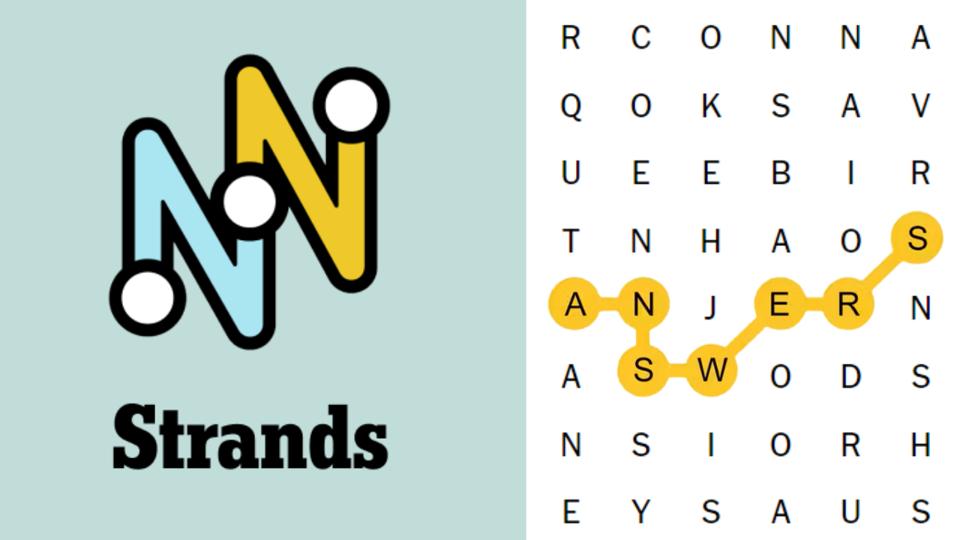
Today’s NYT Strands puzzle blends the satisfaction of word-search and word-game logic with the crisp clarity of mathematics vocabulary. Across the 6×8 letter grid, you’ll hunt for familiar math-related terms — from basics like graph to more formal concepts like theorem — all tied together under the playful theme “It all adds up.” This edition rewards pattern recognition and a little classroom memory, making it accessible yet rewarding for solvers across the US, UK, and India. Whether you’re knocking out the spangram quickly or piecing together each theme word one by one, today’s puzzle offers both challenge and charm.
What is NYT Strands?
NYT Strands is a daily word puzzle from The New York Times that asks players to find a set of themed words hidden in a 6×8 grid of letters. Letters can be connected in all directions — horizontally, vertically or diagonally — and some words may bend or twist. The goal is to find all the theme-related words and one special long word or phrase called the spangram, which touches two opposite edges of the grid. Once all theme words and the spangram are found, the puzzle is solved.
Strands combines vocabulary, pattern recognition, and thematic insight, offering fresh mental exercise every day.
Today’s Theme – “It all adds up”
For December 3, 2025, the official theme is “It all adds up.” This title points solvers toward words connected with mathematics and classroom arithmetic — terms you’d expect to find on a blackboard, in lecture notes, or scribbled down during problem solving.
Think beyond basic counting — words can relate to functions, formal proofs, visual representations or numeric relationships.
Hints for Today (Non-Spoiler)
Here are some helpful hints if you want to solve without peeking at answers:
-
🔎 Look for terms from algebra, calculus, and general math instruction — many are clues you’ve seen on homework or exams.
-
📊 Words may include types of mathematical expressions or objects — e.g., something plotted, a relationship between variables, or a computed result.
-
🧠 The spangram is two words and refers to the place where you’d often encounter these terms — think classroom or learning context.
-
↔️ The spangram touches two opposite sides of the grid (from bottom to top).
These hints should help you home in on theme words and begin tracing possible long paths for the spangram.
Spoiler Section: Answers & Spangram
⚠️ Skip this section if you plan to solve the puzzle yourself!
🧵 Spangram: MATH CLASS
This two-word phrase captures the core classroom setting where diagrams, formulas, and functions come together.
📚 Theme Words:
Here are the words hidden in the grid — all tied to mathematical language:
-
GRAPH – a visual of mathematical relations.
-
CALCULATION – the act of computing or determining a value.
-
EQUATION – a statement showing equality between expressions.
-
FUNCTION – a mathematical relation mapping inputs to outputs.
-
THEOREM – a proven mathematical statement derived via logic.
Together, these words form a cohesive set of foundational math vocabulary — from procedural terms (calculation) to conceptual pillars (theorem). The spangram “MATH CLASS” reinforces the learner’s environment where all these terms converge.
Strategy Tips for Future Puzzles
Here are some strategies that pay off in Strands day after day:
-
Start with the theme – Think broadly about the category and possible word types it includes.
-
Eye short, distinctive words first – Unique letter combinations often unlock longer paths.
-
Scan diagonals early – Strands loves hiding words crisscrossed at angles.
-
Map partial spangram runs – Finding parts of the spangram early helps carve out the remaining territory.
-
Keep an open search space – Words may bend or zig-zag; don’t just stick to straight lines.
-
Use in-game hint system smartly – Hints help most when you’re stuck on the theme rather than individual words.
Over time, you’ll start spotting patterns and themes quicker — even before using hints!
Final Thoughts
Today’s NYT Strands puzzle (Dec 3 2025) brings an enjoyable intellectual twist with its math-centric theme, offering a blend of familiar schoolroom vocabulary and satisfying deductions. For solvers in the US, UK, and India, this one feels like revisiting old math classes — but with the added delight of dynamic wordplay.
Whether you solved it quickly or needed a little help, today’s challenge is a great example of how NYT Strands keeps daily puzzles fresh and engaging.